Cisco® 890 Series Integrated Services Routers (ISRs) combine Internet access, comprehensive security, and wireless services in a single high-performance device that is easy to deploy and manage. They are well suited for deployment as customer premises equipment (CPE) in enterprise small branch offices and in service provider managed-service environments.
Product Overview
Cisco 890 Series ISRs deliver integrated security and threat defense, protecting networks from both known and new Internet vulnerabilities and attacks. These powerful, fixed-configuration routers provide secure broadband, Metro Ethernet, and wireless LAN (WLAN) connectivity. Service providers offering managed Ethernet WAN services can deploy them in customer locations as CPE. You get centralized and remote management capabilities through web-based tools and Cisco IOS® Software for full visibility and control of network configurations at the remote site.
The 890 routers simplify the deployment of Ethernet WAN services, with end-to-end operations, administration, and maintenance (OA&M), service-level agreement (SLA) monitoring and verification, and configuration management.
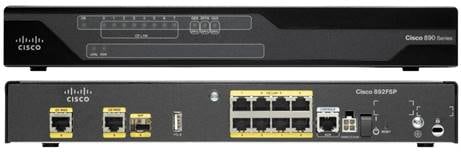
Cisco 890 Series ISRs come with an 8-port managed switch, providing LAN ports to connect multiple devices. An optional Power-over-Ethernet (PoE) capability can also supply power to IP phones and other devices. Eleven Cisco 890 Series models are available: Figure 1 shows the front and back of one, the Cisco 892FSP.
Figure 1. Cisco 892FSP ISR, Front and Back
Features and Benefits
Table 1 describes some of the business needs enterprises have in branch offices and other edge networking locations and how the 890 ISR fulfills those requirements.
Table 1. How the 890 ISR Addresses Edge Networking Challenges
Business Need
|
890 ISR Feature(s)/Description
|
High availability and business continuity
|
● Redundant WAN connections for failover protection and load balancing
● Dynamic failover protocols such as Virtual Router Redundancy Protocol (VRRP; RFC 2338), Hot Standby Router Protocol (HSRP), and Multigroup HSRP (MHSRP)
● Dial backup with external modem through a virtual auxiliary port
|
Consistent, high application performance levels
|
● The router can run multiple services simultaneously with no performance degradation
|
Risk mitigation with multilevel security
|
● Network perimeter security with integrated application inspection firewall
● Data privacy through high-speed IP Security (IPsec) Triple Data Encryption Standard (3DES) and Advanced Encryption Standard (AES) encryption
● Enforced security policy with intrusion prevention
● Security hardware acceleration
● FlexVPN
● Next-generation encryption for secure network communications systems, reliable for the next decade
● Cisco ISR Web Security with Cisco ScanSafe, designed to prevent zero-day malware from reaching corporate networks
|
Feature consolidation for real estate, capital expenditures (CapEx), and management savings
|
● Supports LAN connections, both Ethernet and Wi-Fi, in one appliance. Contains an integrated 802.11n WLAN access point that supports both autonomous and unified modes, as well as an 8-port LAN switch. Management of both the wired and wireless environments is integrated
|
Unified control of wired and wireless networks from a common console for streamlined operations
|
● Simplifies and centralizes configuration and management of wireless and wireline devices. Supports WLAN services without requiring a wireless LAN controller
|
Remote configuration and management to keep local IT staff lean
|
● Supports separate console, auxiliary, and USB ports
● Provides one USB 2.0 flash memory
|
Platform Support
Table 2 describes the interfaces, Wi-Fi options, and integrated capabilities supported by each of the Cisco 890 Series ISR models.
Table 2. Platform Support for 890 Series ISRs
Model
|
WAN Interfaces
|
Integrated Dial Backup
| |||
Cisco 892FSP
|
1-port GE or 1‑port SFP
1-port GE
|
8-port 10-/100-/1000-Mbps managed switch
|
No
|
Yes
|
No
|
Cisco 896VA
|
1-port GE or 1‑port SFP
VDSL/ADSL2+ Annex B
|
8-port 10-/100-/1000-Mbps managed switch (4‑ports PoE capable with 125W power supply adapter)
|
No
|
Yes
|
ISDN
|
Cisco 897VA
|
1-port GE or 1‑port SFP
VDSL/ADSL2+ Annex A/M
|
8-port 10-/100-/1000-Mbps managed switch (4‑ports PoE capable with 125W power supply adapter)
|
Yes
Cisco CleanAir®technology
|
Yes
|
ISDN (only on Cisco 897VA-K9)
|
Cisco 897VAB
|
1-port GE or 1‑port SFP
VDSL/ADSL2+ Annex A with Bonding
|
8-port 10-/100-/1000-Mbps managed switch (4‑ports PoE capable with 125W power supply adapter)
|
No
|
Yes
|
No
|
Cisco 898EA
|
1-port GE or 1‑port SFP
4 pair Ethernet in the first mile (EFM)
|
8-port 10-/100-/1000-Mbps managed switch (4‑ports PoE capable with 125W power supply adapter)
|
No
|
Yes
|
No
|
Cisco 891F
|
1-port GE or 1‑port SFP
1-port FE
|
8-port 10-/100-/1000-Mbps managed switch (4‑ports PoE capable with 125W power supply adapter)
|
Yes
Cisco CleanAir technology
|
Yes
|
V.92 analog modem
ISDN BRI
|
Cisco 891-24X
|
2-port GE or 2‑port SFP
|
24-port 10-/100-/1000-Mbps managed switch (8-ports PoE capable with integrated power supply)
|
No
|
Yes
|
No
|
Product Specifications
Table 3 shows Cisco IOS Software features, WLAN features, and general system specifications for the 890 Series ISRs.
Table 3. 890 Series IOS Software Features, WLAN Features, and System Specifications
Feature
|
Specification
| |
Cisco IOS Software: Advanced IP Features Set (Default)
| ||
IP and IP services
|
● Generic routing encapsulation (GRE) and multipoint GRE (MGRE)
● Standard 802.1d Spanning Tree Protocol
● Layer 2 Tunneling Protocol Version 3 (L2TPv3)
● Dynamic Host Configuration Protocol (DHCP) server, relay, and client
● DNS Proxy
● Access control lists (ACLs)
● IPv4 and IPv6 Multicast
● Open Shortest Path First (OSPF)
● Border Gateway Protocol (BGP)
● Performance Routing (PfR)
● Enhanced Interior Gateway Routing Protocol (EIGRP)
● Virtual Route Forwarding (VRF) Lite
● Next Hop Resolution Protocol (NHRP)
● Bidirectional Forwarding Detection (BFD)
● Web Cache Communication Protocol (WCCP)
| |
xDSL
|
● True Multimode VDSL2 and ADSL2+ over Annex A, B, J, and M including traditional G.DMT and T1.413
● World-class interoperability with industry-standard DSL access multiplexer (DSLAM) chipsets
● Highest field reliability with Impulse Noise Protection over REIN/SHINE, Extended INP-Delay, G.INP, Physical Layer Retransmission, SRA, and Bitswap
● VDSL2 Persistent Storage Device (PSD) profiles up to 17a/b with support for Spectral Shaping
● VDSL2 Vectoring to offer blazing fiber speeds over copper
● Support for 4-pair multimode G.SHDSL; that is, ATM and EFM
● Remote management with TR069 and CWMP
● Investment protection with GE and SFP for future fiber that could replace xDSL deployment
| |
Switch features
|
● 14 802.1QVLANs
● Four-port 802.3af and Cisco compliant PoE
● Storm Control
● Secure MAC address
● Internet Group Management Protocol Version 3 (IGMPv3) snooping
● 802.1x
| |
Security features
|
● Secure Sockets Layer (SSL) VPN for secure remote access
● Public-key-infrastructure (PKI) support
● Cisco Easy VPN Client and Server
● Dynamic Multipoint VPN (DMVPN)
● Tunnel-less Group Encrypted Transport VPN
● VRF-aware IPsec
● IPsec over IPv6
● Adaptive control technology
● Session Initiation Protocol (SIP) application-layer gateway
● Cisco IOS Firewall:
◦ Zone-Based Policy Firewall
◦ Stateful inspection transparent firewall
● Secure HTTP (HTTPS), FTP, and Telnet Authentication Proxy
● Firewall stateful failover
● VRF-aware firewall
● Cisco ScanSafe Connector
● Cisco IOS Software black and white lists
● Integrated threat control:
◦ Intrusion Prevention System (IPS)
● Control Plane Policing
● Flexible Packet Matching
● Network foundation protection
| |
Quality of Service (QoS)
|
● Weighted Fair Queuing (WFQ)
● Class-Based Traffic Shaping (CBTS)
● Policy-Based Routing (PBR)
● Class-Based QoS MIB
● Class of service (CoS)-to-differentiated services code point (DSCP) mapping
● Class-Based Weighted Random Early Detection (CBWRED)
● Network-Based Application Recognition (NBAR)
● Link fragmentation and interleaving (LFI)
● Resource Reservation Protocol (RSVP)
● Real-Time Transport Protocol (RTP) header compression (cRTP)
● Differentiated Services (DiffServ)
● QoS preclassify and prefragmentation
● Hierarchical QoS (HQoS)
| |
Management
|
● Cisco Configuration Express
● Cisco AutoInstall
● Cisco IP Service-Level Agreement (IP SLA)
● Cisco IOS Embedded Event Manager (EEM)
● Telnet, Simple Network Management Protocol Version 3 (SNMPv3), Secure Shell (SSH) Protocol, command-line interface (CLI), and HTTP management
● RADIUS and TACACS+
● Out-of-band management with ISDN S/T port or external modem through a virtual auxiliary port on models supporting those interfaces; refer to Table 2 for details
● Cisco Wireless Control System (WCS) for management of unified access points in models supporting WLAN; on models supporting WLAN, refer to Table 2 for details
| |
High availability
|
● Virtual Router Redundancy Protocol (VRRP) (RFC 2338)
● MHSRP
| |
Metro Ethernet
|
● Ethernet OA&M
● Ethernet Local Management Interface (E-LMI)
● IP SLA for Ethernet
| |
IPv6
|
● IPv6 addressing architecture
● IPv6 name resolution
● IPv6 statistics
● IPv6 translation: Transport packets between IPv6-only and IPv4-only endpoints (NAT-Protocol Translation)
● Internet Control Message Protocol Version 6 (ICMPv6)
● IPv6 DHCP
● OSPFv3
● BGP4+
● IPv6 path maximum transmission unit (PMTU)
● IPv6 Neighbor Discovery
● IPv6 stateless address autoconfiguration (SLAAC)
● IPv6 Multicast Routing
| |
Unified WLAN management
|
● Unified access-point features:
◦ Supported by wireless LAN controller and Cisco WCS
● Configurable local or central switching for Hybrid Remote Edge Access Point (HREAP) mode
● Radio management through Cisco WCS
● Transparent roaming with mobility groups
| |
Application visibility and control
|
● Cisco Wide Area Application Services (WAASx)
● NBAR2
● Flexible NetFlow (FNF)
● Performance Agent
| |
Number of recommended users
|
50
| |
WLAN Features (Available with Wireless Option)
| ||
Standard 802.11 a/g/n access point
|
● Optional on Cisco 890 Series models
| |
WLAN hardware
|
● Automatic rate selection for 802.11a/g/n
● Wi-Fi 802.11n Draft v2.0 certified
| |
WLAN software features
|
● Autonomous or unified access point
● Software-configurable transmit power
● Traffic specifications (TSPEC) Call Admission Control (CAC) to ensure voice quality is maintained
| |
WLAN security features
|
● Standard 802.11i
● EAP authentication: Cisco Light Extensible Authentication Protocol (LEAP), Protected Extensible Authentication Protocol (PEAP), Extensible Authentication Protocol Transport Layer Security (EAP TLS), Extensible Authentication Protocol-Flexible Authentication via Secure Tunneling (EAP-FAST), Extensible Authentication Protocol-Subscriber Information Module (EAP-SIM), Extensible Authentication Protocol-Message Digest Algorithm 5 (EAP-MD5), and Extensible Authentication Protocol‑Tunneled TLS (EAP-TTLS)
● Static and dynamic Wired Equivalent Privacy (WEP)
● Configurable RADIUS accounting for wireless clients
| |
Certifications
| 
Note: Due to new FCC WiFi June 2016 regulation (FCC rules for part 15.409), the WLAN radio used in the ISR's (specifically C819 –A WiFi Domain with AP802 dual 802.11 radio) Cisco will be issuing a new grant for the 5GHz dual 802.11n radio.
The specific reason for the change is due to the inability of the radio to detect the various radar pulses (DFS function) over the entire bandwidth of the channels in the 5250-5350 and the 5500-5700 A radio channel bands (which will be disabled). As a consequence the radio will now operate from 5150-5250 and 5745-5850 A radio bands. This will provide a total of nine channels in the 5GHz range.
| |
Service Set Identifiers (SSIDs) and Multiple Broadcast SSIDs
|
● 16
| |
Wireless VLANs
| ||
Default and maximum DRAM
|
● Default 512MB
● Up to 1 GB on Cisco 892FSP, 896VA, 897VA, 897VAB, 898EA, 891F, and 891-24X data models; upgrade option available
| |
Default and maximum flash memory
|
● 256 on all Cisco 890 ISR models; not upgradable
| |
WAN
|
● Refer to Table 2 for details
| |
LAN switch
|
● Refer to Table 2 for details
| |
Separate console and auxiliary ports
|
● RJ-45
| |
USB 2.0
|
● One USB 2.0 port available on Cisco 892FSP, 896VA, 897VA, 897VAB, 898EA, 891F, and 891-24X
● USB devices supported:
◦ USB flash memory
Note: USB 2.0 ports cannot be used for connecting external devices other than those specified at:http://www.cisco.com/en/US/prod/collateral/modules/ps6247/product_data_sheet0900aecd80232473.html.
| |
ISDN BRI S/T
|
● Refer to Table 2 for details
| |
Inline PoE
|
● Optional internal adapter for inline PoE on 4 switch ports for IP phones or external wireless access points; 802.3af-compliant and Cisco PoE-compliant
● No PoE support on Cisco 892FSP
| |
Wireless specifications
|
● 2.4 and 5 GHz
| |
Data rates supported
|
● 802.11a: 6, 9, 12, 18, 24, 36, 48, and 54 Mbps
● 802.11b: 1, 2, 5.5, 6, 9, and 11 Mbps
● 802.11g: 1, 2, 5.5, 6, 9, 11, 12, 18, 24, 36, 48, and 54 Mbps
● 802.11n: 1, 2, 5.5, 6, 9, 11, 12, 18, 24, 36, 48, 54, and m0-m15
| |
Maximum transmit power (2‑channel aggregate)
|
● 802.11a: 15dBm
● 802.11b: 20 dBm
● 802.11g: 17 dBm
● 802.11n: 16 dBm
Note: Maximum power setting is subject to change by channel and by region, depending on regulations.
| |
Physical dimensions and weight
|
Weight: 5.5 lb (2.5 kg) maximum
Product dimensions:
● Cisco 892FSP, 896VA, 897VA, 897VAB, 898EA, and 891F:
◦ H x W x D =1.82 x 12.71 x 9.78 in. (4.62 x 32.28 x 24.84 cm) (includes rubber feet)
◦ H x W x D = 1.75 x 12.71 x 9.78 in. (4.45 x 32.28 x 24.84 cm) (without rubber feet)
● Cisco 891-24X:
◦ H x W x D = 1.75 x 17.25 x 12 in. (4.62 x 43.81 x 30.48 cm) (includes rubber feet)
◦ H x W x D = 1.75 x 17.25 x 12 in. (4.45 x 43.81 x 30.48 cm) (without rubber feet)
| |
External power supply
|
Product power specifications:
● AC input voltage: Universal 100 to 240 VAC
● Frequency: 50 to 60 Hz
● Maximum output power: 60W
● Output voltages: 12 VDC
● Optional PoE:
◦ Separate 80W PoE power supply for Cisco 891 and 892 ISRs
◦ Single 125W power supply required for Cisco 896, 897, 898, and 891F for router and PoE
◦ The Cisco 891-24X uses the internal power supply for PoE
● External output voltage: 48 VDC
| |
Approvals and compliance
|
● Emission
● 47 CFR Part 15: 2006
◦ CISPR22: 2005
◦ EN300386: V1.3.3: 2005
◦ EN55022: 2006
◦ EN61000-3-2: 2000 [Inc amd 1 & 2]
◦ EN61000-3-3: 1995 [+ amd 1: 2001]
◦ ICES-003 Issue 4: 2004
◦ KN 22: 2005
◦ VCCI: V-3/2006.04
● Immunity
● CISPR24: 1997 [+ amd 1 & 2]
◦ EN300386: V1.3.3: 2005
◦ EN50082-1: 1992
◦ EN50082-1: 1997
◦ EN55024: 1998 [+ amd 1 & 2]
◦ EN61000-6-1: 2001
| |
Environmental operating range
|
● Nonoperating temperature: -4 to 149°F (-0 to 65°C)
● Nonoperating humidity: 5 to 95% relative humidity (noncondensing)
● Nonoperating altitude: 0 to 15,000 ft (0 to 4570m)
● Operating temperature: 32 to 104°F (0 to 40°C)
● Operating humidity: 10 to 85% relative humidity (noncondensing)
● Operating altitude: 0 to 10,000 ft (0 to 3000m)
| |
Ordering Information
Table 4 lists the part numbers and Cisco IOS Software and WLAN software image details for each of the 890 Series ISR models. To place an order, visit the Cisco Ordering Home Page. To download software, visit the Cisco Software Center.
Table 4. Product Part Numbers and Software Images
Product Part Number
| |
Integrated Services Routers
| |
C892FSP-K9
|
Cisco 892FSP Gigabit Ethernet security router with SFP
|
C896VA-K9
|
Cisco 896VA Gigabit Ethernet security router with SFP and VDSL/ADSL2+ Annex B
|
C897VA-K9
|
Cisco 897VA Gigabit Ethernet security router with SFP and VDSL/ADSL2+ Annex A
|
C897VAW-A-K9
|
Cisco 897VA Gigabit Ethernet security router with SFP and VDSL/ADSL2+ Annex A with Wireless
|
C897VAW-E-K9
|
Cisco 897VA Gigabit Ethernet security router with SFP and VDSL/ADSL2+ Annex A with Wireless
|
C897VA-M-K9
|
Cisco 897VA Gigabit Ethernet security router with SFP and VDSL/ADSL2+ Annex M
|
C897VAM-W-E-K9
|
Cisco 897VA Gigabit Ethernet security router with SFP and VDSL/ADSL2+ Annex M with Wireless
|
C897VAB-K9
|
Cisco 897VA Gigabit Ethernet security router with SFP and VDSL2/ADSL2+ Bonding over POTS
|
C898EA-K9
|
Cisco 898EA Gigabit Ethernet security router with SFP and 4 channel multimode G.SHDSL (EFM/ATM)
|
C891F-K9
|
Cisco 891F Gigabit Ethernet security router with SFP
|
C891-24X/K9
|
Cisco 891 Gigabit Ethernet security router with SFP and 24-ports Ethernet Switch
|
C891FW-A-K9
|
Cisco 891F Gigabit Ethernet security router with SFP and Dual Radio 802.11n Wifi for FCC -A domain
|
C891FW-E-K9
|
Cisco 891F Gigabit Ethernet security router with SFP and Dual Radio 802.11n Wifi for ETSI -E domain
|
Cisco 892FSP is supported only on Cisco IOS Software Release 15.2(4)M and later
Cisco 896, 897, 898EA is supported only on Cisco IOS Software Release 15.2(4)M1 and later
Cisco 891F is supported only on Cisco IOS Software Release 15.3(3)M2, 15.4(1)T and later
C897VAB is supported only on Cisco IOS Software Release 15.4(3)M1 and later
C891-24X is supported only on Cisco IOS Software Release 15.5(1)T and later
| |
Memory Options
| |
FL-8XX-512U1GB
|
512 MB DRAM upgrade to 1 GB for Cisco 892FSP, 896VA, 897VA, 897VAB, 898EA, 891F model (Feature License)
|
Router Software Images
| |
Image
| |
Access Point Software Images
| |
ap802-k9w7-tar
|
Autonomous software image for ap802
|
ap802-rcvk9w8-tar
|
Lightweight Access Point Protocol (LWAPP) recovery image for ap802
|
Power over Ethernet Options
| |
800-IL-PM-4 with 125W PSU
|
4-port 802.3af capable internal power module for C896, C897, C898, C891F routers
|
Security Services
| |
Scan SafeCloud Web Security
| |
ScanSafe Connector
| |
Supported SFP Types on the Cisco 892F Series and Cisco 892FSP, 896VA, 897VA, 897VAB, 898EA, 891F
| |
GLC-LH-SM
|
1000BASE-LX/LHSFP transceiver module for MMF and SMF, 1300-nm wavelength, dual LC/PC connector
|
GLC-SX-MM
|
1000BASE-SXSFP transceiver module for MMF, 850-nm wavelength, dual LC/PC connector
|
GLC-ZX-SM
|
1000BASE-ZXSFP transceiver module for SMF, 1550-nm wavelength, dual LC/PC connector
|
GLC-BX-D
|
1000BASE-BX10SFP module for single-strand SMF, 1490-nm TX/1310-nm RX wavelength, single LC/PC connector
|
GLC-BX-U
|
1000BASE-BX10SFP module for single-strand SMF, 1310-nm TX/1490-nm RX wavelength, single LC/PC connector
|
GLC-T
|
1000BASE-T standard
|
GLC-GE-100FX
|
Cisco 100BASE-FX SFP for Gigabit Ethernet SFP ports with multimode fiber-optic (MMF) link
|
GLC-FE-100LX
|
Cisco 100BASE-LX10SFP with single-mode fiber-optic (SMF) link
|
GLC-FE-100BX-U
|
100BASE-BX10-U SFP module for 100-MB ports, 1310 nm TX/1550 nm RX wavelength, 10 km over single-strand SMF
|
GLC-FE-100BX-D
|
100BASE-BX10-D SFP module for 100-MB ports, 1550 nm TX/1310 nm RX wavelength, 10 km over single-strand SMF
|
CWDM-SFP-1470=
|
Cisco Coarse-Wavelength Division Multiplexing (CWDM) 1470-nm SFP Gigabit Ethernet and 1G/2G fibre Channel
|
GLC-LH-SMD*
|
1000BASE-LX/LH SFP transceiver module for MMF and SMF, 1300-nm wavelength
|
GLC-ZX-SMD*
|
1000BASE-ZX SFP transceiver module for SMF, 1550-nm wavelength, dual LC/PC connector
|
GLC-EX-SMD*
|
1000BASE-EX SFP transceiver module for SMF, 1310-nm wavelength
|
*Not supported on the Cisco 892F
| |
Rack Mount Kit for 890
| |
ACS-890-RM-19
|
Rackmount kit for all 890s, except C891-24X
|
ACS-2901-RM-19
|
Rackmount kit for 891-24X
|
FL-C890-WAASX
|
WAASx Feature License
|
Cisco and Partner Services
Services from Cisco and our certified partners can help you reduce the cost and complexity of branch-office deployments. We have the depth and breadth of experience across technologies to architect a blueprint for a branch-office solution to meet your company's needs. Planning and design services align technology with business goals and can increase the accuracy, speed, and efficiency of deployment. Technical services help maintain operational health, strengthen software application functions, solve performance problems, and lower expenses. Optimization services are designed to continually improve performance and help your team succeed with new technologies. For more information, visithttp://www.cisco.com/go/services.
Cisco SMARTnet® technical support for the Cisco 890 Series ISRs is available on a one-time or annual contract basis. Support options range from help-desk assistance to proactive, onsite consultation. All support contracts include:
● Major Cisco IOS Software updates in protocol, security, bandwidth, and feature improvements
● Full access rights to Cisco.com technical libraries for technical assistance, electronic commerce, and product information
● 24-hour access to the industry’s largest dedicated technical support staff
